Showing posts with label Matt Smith. Show all posts

Tuesday, 3 June 2025

The Sarah Jane Adventures: Death of the Doctor

Chapter the 330th, in which Doctor Who appears to be dead, but returns before you know it (let's hope life imitates art).


Plot:
Sarah Jane, Clyde and Rani are invited to the funeral of the Doctor, held in a UNIT base within Mount Snowdon. Sarah Jane does not believe the Doctor is dead, which the others put down to denial. Another old friend of the Doctor, Jo Jones, attends with her grandson Santiago. She also doesn't believe the Doctor is dead. The funeral is arranged by the Shansheeth, an alien race that look a bit like vultures who act as undertakers across the galaxy. Clyde's body keeps crackling with energy that he absorbed from the TARDIS when he last met the Doctor: suddenly, he changes into Matt Smith. The Doctor has been stranded without the TARDIS on a planet, but has constructed a gizmo to let him switch places with Clyde temporarily. He takes Sarah Jane and Jo with him when he goes back to the planet, and they help him to cross back permanently. The Shansheeth and UNIT Colonel Karim conspired to strand the Doctor and steal his TARDIS, but they don't have the key. They capture Sarah Jane and Jo and wire them up to a device that will create a new key from their memories. The Doctor, the kids and a Groske that works for UNIT are trapped outside of the room when this is happening. Through the door, the Doctor encourages his two ex-companions to remember everything of their adventures. This overloads the machine. It explodes, killing the villains.

Context:
I gave this spin-off a pre-screening screening by asking the usual set of questions. Does it star the Doctor? Yes. Was it released as an official Doctor Who or spin-off story (i.e. its not an unofficial fan-made proposition)? Yes. Is there a dramatic context to the story (i.e. it's not just a skit)? Yes. Was it released with the intention of being the main attraction for audience engagement (i.e. it's not just an extra on a DVD or Blu-ray)? Yes (it did end up being an extra on the Blu-ray collection season 10 box set disc, from where I viewed it this time, but it wasn't created to be so). Have I already covered it in passing with another connected story? No. A full house of correct answers means that the story adheres to the - somewhat arbitrary, I grant you - rules of suitability for inclusion in this blog. I watched the episodes one a day on the last two days of May 2025.


Milestone watch: I've been blogging new and classic Doctor Who stories in random order since 2015, and I'm now closing in on the point where I finish everything and catch up with the current stories being broadcast serially. When not going off piste with stories like Death of the Doctor, I have completed 11 Doctor's televisual eras, Doctors 1-4, 7-9 and 11-14, which entailed completing 37 out of the 41 seasons to date (at the time of writing): classic seasons 1-18, 20, 21, 23-26, and new series 1, 2, and 4-14.

First Time Round:
I can't remember the details, but I remember the feels. I watched this when it was first shown in October 2010, probably from a recording on the PVR later on each of the days of transmission. I was probably accompanied by the Better Half, but not by either of our only two children at the time as they were still a little too young. I enjoyed it immensely, as I did again on this recent watch, and for the same reasons: it's fun, well paced and celebratory. Whisper it, but it was probably the most enjoyable Matt Smith story of 2010 for me (I'm not as keen on Matt Smith's first season as many are).


Reaction:
What a difference a year makes. Death of the Doctor is a loose 2010 sequel to the last Sarah Jane Adventures story that featured a guest appearance from the Doctor in 2009. In that instance, as I mentioned when I blogged it in January 2025, the story scaffolding surrounding the guest casting was pretty flimsy. Just having David Tennant appear seemed enough, without having to construct a strong story in which he could feature. The writer of Death of the Doctor Russell T Davies puts a lot more into this and it's therefore much more rewarding to watch. The masterstroke is to have another guest star appear as well as Matt Smith. This is Katy Manning as Jo Jones née Grant, another companion from the same era as Sarah Jane. Manning gives every scene she's in a lift; Lis Sladen is very good within a narrow range, and can do the dynamic moments, but she's not so good at emotion. Manning can handle the emotional moments perfectly: witness the scene where she asks the Doctor why he never came back to see her again. This then leads into a wonderful revelation that Tennant's pre-regeneration victory lap towards the end of his last episode, where he visited lots of new series companions - which would have been relatively fresh in the audience's memory after its original broadcast on the 1st January of 2010 - extended to his catching up with every one of his companions. Obviously, on one level it's fanwank, but it's also lovely. The little moments talking about other companions (Liz Shaw working on a moonbase, Ian and Barbara having got married, Ace setting up her own charity, etc.) are also great. The story then climaxes with loads and loads of archive clips. What more could one ask for? Davies might never have written for the Doctor again after this story, and he clearly wants it to be a celebration of Doctor Who and the Doctor's positive impact on people.


Matt Smith gets some great gags, but also some more melancholy material like the line about regeneration "It always hurts" that he almost throws away, making it all the more powerful by doing so. The younger regulars are their usual good value. You could lift the Santiago Jones character out of proceedings and not impact the plot one jot, but it's great to have Rani and Clyde with their own sort-of companion, comparing their adventures with his life supporting family members in environmental protesting. Rani and Clyde have the benefit of always going back home after their escapades to normality and safety (a metaphor perhaps for the enjoyable but safe escapism of Doctor Who and associated Whoniverse shows). There's even time for the script to say a few simple but nonetheless true things about grief and loss. There's fun villains and monsters to provide some salt and avoid things becoming too saccharine. The Groske, friendly aliens who look like nastier cousins that the Bannerman Road gang have encountered before, are also pretty superfluous to proceedings; they do, though, provide a few nice moments of comic relief that it would be a shame to lose. For example, there's the sequence where a Groske encourages Rani, Clyde and Santiago to hurry along to its hidden sanctuary, only to reveal that it has no plan beyond hiding, and just wanted to hurry so its pizza wouldn't go cold. Laila Rouass has a lot of fun playing a UNIT officer gone rogue, tempted with the chance to leave Earth behind. The sneering delivery of her put-downs directed at Sarah Jane ("Frankly, I've never met anyone so staggeringly pious in all my life") are worth the price of admission on their own.


The Shansheeth are also a fun enemy race, if a little bit too Jim Henson in their look to be truly scary. Their motivation, though, is nicely original; tired of the ravages of mortality witnessed in their work as space undertakers, they want to prevent death in the universe. Davies mentioned in the commentary for the story that the Shansheeth's nefarious plan to nab the TARDIS broke his rule that the Doctor's time machine should never be the antagonists' prize (drawing attention to the power of the TARDIS too much would invite audiences to wonder why the villain every week didn't abandon whatever plan they had on hearing about it, as it would be more valuable than anything they'd previously had in their sights). It does help to up the ante at the end, though. The effects work to visualise a base in Mount Snowdon and a rocket ready for blast off are pretty good for the minimal budget of a CBBC show. There's great voice work from Jon Glover and David Bradley as the Shansheeth (the latter would be invited back a few times to appear in person in the main show). There's lots of fun continuity references for those that like that sort of thing (Jo mentions Karfel, tying up a loose end of continuity from the Sixth Doctor story Timelash, which sees the Doctor return to a planet that he'd previously visited with Jo in an unseen Jon Pertwee adventure). Beyond all of that, this is the story that depicts the first ever meeting of Sarah Jane and Jo Grant, and for that it gains special status and should always have a place in fans' hearts.

Connectivity:
Both Death of the Doctor and The Story and the Engine feature the Doctor as played by Matt Smith (he's in a blink and you'd miss it clip in the Ncuti Gatwa tale). Both stories involve the antagonists trapping the Doctor in another time- and space-zone away from other characters, but in both his companion(s) eventually join him to help him escape the trap. In a reasonably sizeable coincidence - Doctor Who doesn't do such a thing that often -  both stories climax with a sequence featuring lots of clips of Doctor Who representing the memories of characters being used to overload a machine.


Deeper Thoughts:
The Story is the Engine: Anniversaries and Endings - 2. [Spoilers follow for the end of Ncuti Gatwa's second season - don't read unless you've watched The Reality War.] In the first part of this musing in the Deeper Thoughts section of the previous blog post, I talked about blogging all remaining classic and new series stories before the end of year; but, of course, anything could happen between now and the end of the year. The world could end. There might suddenly and unexpectedly be so many new Doctor Who stories created and broadcast on TV in late 2025 that I couldn't possibly write them all up before the 31st December (sadly, the world ending seems more likely as things stand). As mentioned above, when Russell T Davies wrote Death of the Doctor it probably seemed to him that he was writing for the Doctor for the very last time. In the end, that didn't turn out to be the case. As I write this in early June 2025, in the twentieth anniversary year of the new series launch, the time has come again when Davies may have reached the end of his time writing for the Doctor. All is uncertainty as we wait for news. Stories are a tool that humans have created to help them deal with the uncertainties of the world. It therefore feels a little unfair that Doctor Who fans' favourite coping mechanism has been taken away, just as the world for us has got just a little bit less good. We've been lucky up to now, though: through those twenty years, there's never before been a period when a Doctor Who season ended before the next one had been commissioned (and usually had started production). We now have that situation, and don't know exactly how long it will endure. Things could change before these words are even read. After I publish, Disney+ could confirm funding for another season the next day, the next week, the next month. The smart money (with the caveat that there is no smart way to make such a prediction) is on it taking longer than that, though: to my mind, this explains decisions taken with The Reality War's ending.


There are two facts that are certain. First, Ncuti Gatwa decided to move on from the role of the Doctor. Second, Disney+ had not made a decision about continuing to fund the series - and therefore it was not known exactly how the series would continue - before Gatwa's last episode was due to be broadcast. We don't know exactly when the decision about Gatwa's departure took place. A large amount of material towards the end of The Reality War looks to be constructed around his self-sacrifice. Too much to have been created with hasty pick-up shots? Maybe. My feeling is that he probably would have done a third year if Disney+ had not prevaricated, but we'll probably never know for sure. However it came about, the situation created a challenge for Davies in the writing of the final seconds of The Reality War. Ncuti has to be seen to regenerate, or else he'll still be associated with the role while trying to make a name for himself with other work. This would probably be true even if the regeneration was seen to start but not finish: it would leave open the possibility that he could continue (as David Tennant did after seeming to regenerate at the end of The Stolen Earth, for example). Someone brand new couldn't appear at the end without the guarantee of future work, for the same reason of unfair association with and responsibility for the show. So, it had to be someone already associated with the show in a big enough capacity that further association would not hurt the brand, and successful enough in their own right that the association wouldn't hurt their career. Any of the actors who'd played the Doctor before could have been candidates, but unfortunately Davies had already pulled that trick when David Tennant took over from Jodie Whittaker in 2023. It therefore would have to be a companion actor.


Of the small number of candidates that fit the bill, the ones with a previous working relationship with Davies probably boiled down to two, Catherine Tate and Billie Piper. As Tate had already returned in 2023 too, there was only really one choice. This doesn't mean it's not genius, though: Piper's presence harks back to the relaunch, when she was arguably the most crucial cast member of the first two years of the new series. The credits of The Reality War and the BBC's press release are careful never to refer to Piper as playing the Doctor. This leaves Davies's (or someone else's?) options open for when (if?) things resume. A quick decision on the future of Doctor Who could just about make a Christmas special for December 25th 2025 a possibility; what's more likely is a special or specials in 2026, with Piper handing over to someone else to do a series in 2027. Or it could be the end of Doctor Who altogether. It would be a shame as there are lots of ends left deliberately loose still to be tied up (who exactly is "the Boss"?) and scripts have been written for the next season and beyond. Also, the last ever image of Doctor Who being Ncuti Gatwa turning into Billie Piper is not as fitting as the Doctor and Ace walking off into the sunset (which served as the final image from 1989 to 1996). It certainly feels like there's confidence that the wait won't be too long (but then, one might have thought that about a newly regenerated Paul McGann flying his TARDIS off to adventures new, which served as the final image from 1996 to 2005). We'll have to wait and see (just as we did, for quite lengthy periods after 1989 and 1996). If news does come, I might miss it, at least for a while. I went into my viewing of The Reality War knowing the rumours about Ncuti leaving and regenerating into Piper, and it would have been much better not to have known.


As I've mentioned on the blog before, I don't engage with any social media any more, and I get all my news (except Doctor Who news) offline. I'm much happier for doing this, and I would recommend the approach to anyone. The fear of missing out, though, tempts me to regularly google 'Doctor Who' and look at news articles. I'm going to stop that too now. With no stories being made I'm not likely to see any spoilers, but there are other dangers. Stories are ways to help us manage the uncertainty of life, but there's a different and uglier type of storytelling too. Whether just for clicks (negative stories attracting more attention), or as a stick with which certain other media outlets can beat the BBC, or because of a more general anti-woke agenda, whatever that means exactly, a narrative is already being pushed that Ncuti Gatwa's time as the Doctor was a "flop" with "plummeting" ratings. I'd just like to use a few words here to show how that's complete bollocks. The average consolidated 7-day ratings figure for the first six episodes of the second Gatwa season is 3.18 million viewers. This is a slight drop on the average for last year's season of 3.71 million, but it's a very small drop (not a plummet or a "nosedive"). It's likely that when the final two stories' figures are included, the drop will be even smaller, possibly non-existent. The figure of 3.71 is down on the average figure for Jodie Whittaker's last season too, but then almost every year since 2005 has seen Doctor Who's average ratings go down compared to the previous year. The only exceptions were David Tennant's final season and Jodie Whittaker's first, the averages for both of which were buoyed up by a single outlier rating, because an aspect of that episode snagged on to the public's curiosity (what's the first female Doctor going to be like, and is Tennant going to regenerate earlier than we thought?).


This year-on-year decline is no surprise as it's happened across the board to all other programmes too. As such, Doctor Who is holding its own, particularly when one considers that each episode is usually available to stream before it is broadcast on TV, meaning that overnight and even 7-day figures will never give the whole picture. As was seen with the bump in viewing figures for the 2025 Eurovision-themed episode - which formed part of a live viewing experience with the contest itself for those at home making a night of it - people will tune in live when there's a hook (this is also borne out for special episodes, which tend to perform better than episodes that form part of seasons, and always have). If people aren't motivated to watch live, they will still catch up with the story at some point, Doctor Who episodes on the iplayer have a 'long tail'. Isn't the point of the streaming age that people can watch whenever they want? I'm sure there will be many people who held off from watching any of the season until it was complete, so they could binge it as a box set. I will not be sorry to miss tabloid newspapers misreporting such statistics, and then assigning spurious explanations tied to their own agenda. None of this means that Doctor Who will necessarily come back to TV anytime soon, of course. If I'm disciplined and stick to avoiding any online Who news, the next I know about the future of Doctor Who will be in the pages of Doctor Who Magazine. For example, it will be interesting to see whether Billie Piper starts to appear in the magazine's comic strip, or whether they stick with Ncuti, or indeed do something different altogether. There will still be Big Finish audios too, of course, and probably some more original novels as well. What did I foolishly say earlier about losing our coping mechanism? You don't get rid of Doctor Who stories so easily: they'll likely run and run - and be a force of positivity, unlike some other stories out there - forever.

In Summary:
A very enjoyable story that works as a celebration of the Whoniverse.

Thursday, 17 October 2024

The Hungry Earth / Cold Blood

Chapter the 312th, which depicts the war between the land and slightly under the land.


Plot:
The Doctor, Amy and Rory land in a Welsh village in 2020 that is somehow populated only by one family (it's probably something to do with Covid restrictions, it being 2020). A nearby drilling project has penetrated to a record-breaking depth, but this seems to have woken up something under the ground. The father of the family Mo has gone missing, and based on the Doctor's investigations he was sucked down below the ground. Soon, Amy disappears this way too. Rory and the Doctor protect the others - Mo's son Elliot, Elliot's Mum Ambrose, Ambrose's Dad Tony, and Tony's colleague on the drill project Nasreen - when a group of creatures travel up from below and attack. Eliot is taken, but the Doctor and Rory manage to trap one of the creatures. It is a Silurian - one of the original inhabitants of the Earth from prehistory - called Alaya. The Doctor and Nasreen travel in the TARDIS to the Silurian city under the ground to negotiate a hostage exchange. They find a vast colony, most of whom are in suspended animation. Mo and Amy have been held there by a scientist Silurian Malohkeh, but manage to escape. They find Eliot in suspended animation, but can't release him, then catch up with the Doctor and Nasreen.


Silurian military commander Restac, who is a relative of Alaya's, wants to kill all the humans, but Malohkeh wakes up their leader Eldane who prevents this. Elliot is released. Meanwhile, on the surface, Tony is ill from a Silurian sting; this, plus fears for her missing son, leads Ambrose to torture and kill Alaya. Amy and Nasreen negotiate with Eldane on behalf of Earth. But Rory, Ambrose and Tony arriving with Alaya's body puts a bit of a dent in those proceedings. Tony has set the drill to destroy the Silurian underground city, but the Doctor sends a timed energy pulse to destroy the drill. Eldane agrees - a bit too readily - to put his people back in suspended animation and wait 1000 more years, with the humans agreeing to spread the word down the generations to prepare for an amicable solution at that time. Restac goes on the attack, killing Malohkeh. Eldane sets off toxic fumigation to force the Silurians back into hibernation, so Restac is without her army. Tony decides to stay and go into hibernation too, so he can be cured of the Silurian venom in a millennia's time. Nasreen stays with him. The others race to escape before the drill explodes. As they reach the TARDIS, they see the mysterious crack that's been following them around the universe. The Doctor risks pulling a piece of shrapnel out of the crack to see if he can work out what caused the explosion that fractured reality. Restac staggers into view, dying from the toxic fumes and shoots Rory. He falls near the crack, and the time energy escaping from it erases him from existence. Amy forgets him. After dropping Mo, Ambrose and Elliott home, the Doctor examines the shrapnel - it's a piece of the TARDIS door.


Context:
Watched from the disc in the series five Blu-ray box set in early October, with a week's gap in between the episodes. I was accompanied by two of my three children, boy of 15 and girl of 12 (the eldest is now living away from home at university, and we miss him). Both of them were tickled by the 'futuristic' setting of the year 2020, and made comments about nobody in the narrative wearing masks or socially distancing (but it could be set in January or February 2020, of course). The youngest proudly told me before the first episode that Doctor Who had featured in Heartstopper (characters are seen watching David Tennant in The Runaway Bride in the latest run of that Netflix series).

Milestone watch: I've been blogging new and classic Doctor Who stories in random order since 2015, and I'm now closing in on the point where I finish everything and catch up with the current stories being broadcast serially. Another domino falls, as this post marks the completion of eleventh Doctor Matt Smith's entire televisual Doctor Who era. This makes a total of four Doctors done so far (the seventh, eighth and fourteenth Doctors having been completed before Smith). This post also marks the completion of another season, the 29th out of the total of 40 seasons to date (at the time of writing): classic seasons 1, 3, 4, 5, 7, 8, 10-12, 14-18, 20, 21, 23-26, and new series 2, 4, 5-7, 9-11, and 13).


First Time Round:
I always have trouble remembering my first impressions of Matt Smith stories; don't know exactly why. It's probably a combination of factors - it's a while ago now, the series wasn't as much of a novelty as the early period after the 2005 relaunch, and I had more going on in my life. What I have done in the past if I came up short was to use the First Time Round section to tell a completely different anecdote, mostly from the wilderness years when the show wasn't on TV as a regular series: nearly dying on New Year's Eve 1985watching Blakes 7 videos with my school friend Paul, reading Doctor Who Magazine back copies rather than revising for my A-levels, interviewing for a university place in Durhamnot attending a Doctor Who convention in my first week at university, being accused of shopliftingattending a Tom Baker book signing, and what it felt like to be a fan in the slump between the years 2000 and 2003. I've run out of those anecdotes now, so will have to rack my brain for something that was going on in May 2010. Oh, of course, it was the beginning of the end of my country. A few weeks earlier (just before The Vampires of Venice) a general election in the UK had returned a hung parliament, so there were a few days of negotiations. Then, just before Amy's Choice, the leaders of the Conservative and Liberal Democrat parties, David Cameron and Nick Clegg, had made a speech from the Rose Garden behind 10 and 11 Downing Street. They had formed a coalition government, allowing the Conservatives (the majority partner) to systematically dismantle anything and everything good. Policies would have started to be announced around the time of the Silurian two-parter, including the Fixed Term Parliament Act, which mandated that there would be minimum five years before there was a chance to get them voted out. Maybe this is why I struggle to remember the period - at some conscious or subconscious level, I don't want to.


Reaction:
The problem with reviewing any story featuring Malcolm Hulke's lacertilian legions is what to call them. At various points they have been known as Silurians, Eocenes, Earth reptiles, Homo Reptilia and probably a few more handles I've forgotten. I will stick with Silurians; even though it is wrong, it was what they were first called. Another problem with the Silurians is that they are a great concept, but a difficult fit for Doctor Who stories. Their backstory is more complex and lengthy than some other villains, which is not the best for filling in new viewers with on the fly during an action adventure storyline. The Doctor dumps all the info over the audience in a speech in the second part of this story. In two times 45 minutes of story, why was there no opportunity to tease this information out more gradually? Well, most of the first episode withholds the Silurians' identity and appearance to ramp up the tension and excitement. I wouldn't necessarily want it done differently, as the first part is rather good. The scenes of characters being sucked under the Earth, the siege scenes with Silurians barely perceptible, zooming past the camera as a blur, the distorted POV of characters being experimented on by a Silurian in a surgical mask. It's all great. Sooner or later, though, if the concept is going to be treated appropriately, the horror movie has to turn into the more sedate drama of people sat round a table negotiating. Trying to meld those two halves together in a coherent way is difficult. The original Silurians story from 1970 is essentially the same, horror and action adventure at the start and end, negotiations in the middle. It probably seems more harmonious as a whole than the more jarring changes in the Matt Smith story only because the length (seven episodes) smooths out some of the joins.


I don't fault the writer Chris Chibnall or director Ashley Way. The flaw is built in to the central concept, which tries to have its cake and eat it by presenting the Silurians as both a set of horror monsters, and as a group of people with legitimate claims. For example, Alaya - the first Silurian we are presented with in the story - is aggressive and prejudiced against humans to a ridiculously heightened degree. She makes the race seem less than empathetic, undermining the second part; but, she has to be nasty enough to be killed by a human; if she isn't, then there wouldn't be any dramatic tension in that second part, where her death undermines any chance of a peaceful solution. The two conflicting halves cancel each other out. Even if Chibnall hadn't given Alaya the taunting and manipulative dialogue, she looks like a monster, so inevitably would appear to be one in the visual grammar of Doctor Who. Obviously, the one addition to Silurian biology made in this story, a whiplash tongue with venom sting, isn't helping matters either. Many would say that Alaya's just one of a species that are infinitely varied just like humans; but, one of the more peacenik Silurians is scientist Malohkeh, played by Richard Hope, and he experiments on people. Why spend the first episode framing him as Doctor Mengele if you want him to be sympathetic? For the thrills, obviously. When the potentially more sensible negotiations section starts, it has two randos representing Earth. This seems to stem from having so very few characters in the story, probably for reasons of narrative or production economy (or both). If the Silurians agreed to terms, though, how in hell would Amy Pond and Nasreen Chaudhry have then persuaded the nations and governments across the globe? It's silly, and glaringly obvious from the outset that things will go back to the status quo with the Silurians hibernating again, and the issues side-stepped.
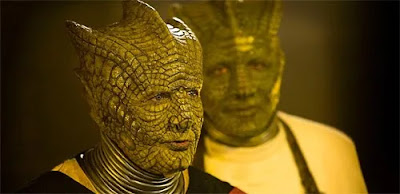

This is problematic because of the real world analogues of this fictional conflict. It doesn't need much spelling out: "We have a claim to this place extending far back in time", "Yeah, well you haven't been around for a long time and we live here now", "We will retake this place, it's our historic birthright", "No way, where would we live?", "Not our problem, you need to make way for our settlements", "Not without a fight", etc. etc. These sort of conflicts have occurred throughout history right up to the present date, and therefore need to be treated sensitively. It's troublesome to interrogate such issues in dramatic form if one side are dressed as lizard people. Even if we could put aside the risk of crassness - it's only a fantasy show aimed at a family audience after all, not meaning to offend - what is the best we could discover? The morality of such conflicts is complex, and the best we are likely to end up with after 90 minutes is philosophy at approximately the level of Culture Club's The War Song. If we dispense with the backstory, we would just have Silurians doing traditional Doctor Who monster stuff; to be fair, that's what their creator Malcolm Hulke ended up doing. In the follow up to his first Silurian story, The Sea Devils, the earth reptiles are reformatted to just be action adventure antagonists with the moral complexity largely ignored. Similarly, Silurians have made many returns to Doctor Who after this 2010 reintroduction, but there haven't been any more land claim negotiations included in those stories. That aspect seems to have gone into permanent hibernation. At the time of writing, though, a Doctor Who spin off is in production featuring the Sea Devils, which from the title - The War Between the Land and the Sea - might just be dabbling in that moral complexity again. Perhaps over a five episode mini-series that doesn't have to be Doctor Who exactly it can be made to work.


Other points of note: the moments from the wider series arc are much more successful than the Silurian story. The mysterious crack turning up in the end is very unexpected and dramatic; Rory's death scene and the scene where Amy tries to hold on to her memories of him but fails were both well played and emotional. The reveal that the shrapnel the Doctor has pulled from the crack is a part of the TARDIS exterior is nicely intriguing. The new design of Silurian make-up is effective. The regular cast are all on good form, particularly Arthur Darvill as Rory. It's got a phenomenal guest cast. Neve McIntosh gets the most interesting material to work with, and makes an indelible impact in both of her two roles. She got to return regularly to play a more nuanced Silurian in future stories. Everyone else is wasted to a greater or lesser degree bringing life to dull characters. Enough time has now gone by for Meera Syal and Robert Pugh to come back to the series playing other roles; it's too late for Stephen Moore, alas. There was definitely mileage in a claustrophobic chiller with a small group of people trapped with a violent and manipulative Silurian; there was probably mileage in a grander, more epic story of two races trying to find peace; trying to do both dragged the resultant story down.

Connectivity:
The Hungry Earth / Cold Blood and Survival are both themed around the dangers of conflict; both feature sequences set underground and races that are anthropomorphised versions of creatures found on Earth (cheetahs in Survival, non-specific lizards in the Silurian 2-parter).


Deeper Thoughts:
From reptile scales underground to musical scales underground: Part 2 of The Happiness Patrol BFI events write-up, Q3 2024. At the end of the first part of this epic - see the Deeper Thoughts section of the Survival blog post - an email had arrived. A week after the wrong version of The Happiness Patrol was shown, the BFI contacted attendees including yours truly to generously and unexpectedly offer free tickets to a rescheduled event where the new special edition version would be showcased, definitely and for reals this time. As it was inserted into the schedule at the last minute, the new screening was at an awkward time, 4.30pm in the afternoon on a Sunday, 29th September (about a month after the initial screening); three of us (me, Chris and Alan) were still able to attend. The later than usual start made travelling up less frantic, and we met for a spot of Sunday lunch before the screening, then ambled along the South Bank to the BFI and took our seats in the NFT1 theatre. Hosts Justin Johnson and Dick Fiddy made merry with the unusual situation from the off: "Welcome to the monthly screening of The Happiness Patrol" said Johnson, with Fiddy joking that in a month's time they would be showing an 8mm black and white version. Turning serious for a brief moment, Johnson gave appreciation to everyone, audience and panel members, that had made it back for this rescheduled slot, but then added of Sheila Hancock that "She's been banned from today's event; she spoke too much". The first item on the agenda was the social media round-up, with Johnson suspecting that some people were now making comments in the run up to BFI events deliberately to get read out, as with the tweet saying that fans who attended both times could "say that they've been double-Dicked". Johnson deadpanned that he was "horrified" that anyone would think he ever used Dick's name as a double entendre.

NFT1

After the quiz, with a final jokey and rhetorical question ("What is the name, address and phone number of the person at the BBC that sent the wrong files?"), there was the first instance of what Fiddy jokingly called "Deja Who". Pete McTighe, a major creative force behind the Blu-ray range, instrumental in creating the special edition of The Happiness Patrol, was invited to the stage to whet the appetites of the assembled about what they were about to see. In other words, to give the same interview he had given a month before. He revealed from his pocket a Blu-ray of the correct version of the story that he'd brought "just in case", and again talked about the insertion of cut material and restructuring of the narrative that had been done to what he feels is an "underrated gem" featuring two stars of the show "at the height of their powers". Again, he highlighted that the intention was to build up the world of Terra Alpha more than could be done with the original budget of "20 quid and a ham sandwich". After McTighe, there was another returning guest: model-maker and puppeteer Stephen Mansfield. This time he hadn't brought the Fifi puppet with him, as it had been assumed that the same people would be attending as had done the previous month, so all would have seen it already. A quick poll of the audience with a show of hands demonstrated this view was only half right: the audience was about 50/50 split between single and double-Dickers (any free tickets that hadn't been claimed by original attendees were put on general sale). Mansfield came up with a few new comments for those of us that had been before. A crucial moment for him was Fifi's death scene, which comes at the end of the story but was shot early on. It is a "tall order" to expect a puppet to be convincing all the time, and he was worried until he saw the emotion that could be wrung from a good actor such as Sheila Hancock working with his co-creation. He relaxed after that.

Our hosts

The house lights then went down, and the first two episodes of the story (in the correct new edition, no doubt to many gasps of relief) were shown. I was skeptical going in, but what has been achieved in these updated episodes is miraculous. The CG backdrops can never have quite the detail or feel of physical sets shot on video, and yet there are seamless sequences where the camera pans from one to the other, or they both share the same frame. McTighe's world building aim has definitely been achieved. The narrative has more time to breathe, with additional scenes inserted of the Doctor and Ace exploring. Lesley Dunlop's Character Susan Q seemed to suffer most from the drastic editing for time that was done on the original, and there are many more sequences featuring her now. There's also much more humour, like the moment where the Kandyman says "I don't give interviews" or a character from this very bureaucratic world tells another that "You need a permit to hide here". There is some reordering of material, but nothing jars and things flow along nicely. It wasn't just the episodes that were new on this day in September; the BFI had done a good job in providing some new onstage content too. After the two-thirds point of the story had been reached, there was a brand new onstage panel focussing on the sonic aspects of the Happiness Patrol. This featured Dominic Glynn (composer of the incidental music for the Happiness Patrol), Adam Burney (the harmonica player featured on the story's soundtrack) and Mark Ayres (audio restoration whizz for the Blu-ray range, amongst many other things). Ayres commended the new edition version that we'd just seen, describing The Happiness Patrol as "a lost classic, hopefully now being able to shine a bit".

(L to R) Johnson, Fiddy, McTighe

Glynn thought the story was a "wonderful gift" as music was built into the script; plus, the styles required varied wildly from awful lift muzak to the soulful harmonica motifs. Burney, who was only 19 when he performed said motifs, explained that all his work took place after the TV studio sessions. Like many an auditioning actor ('of course I can ride a horse'), Richard D. Sharp, who played the harmonica player Earl Sigma in the story, had said he could play. On watching the footage it quickly became clear that he couldn't. Burney had to shape what he was playing to best match Sharp's movements: "I think we got away with it". Ayres explained that as part of his remastering job, he noticed there was one brief moment of Sharp's performance still in there, which came as a surprise to Burney. Sylvester McCoy's live Television Centre performance of the spoons is still intact on the original recordings, and survives to the new edition. To extend Glynn's original set of cues to cover the new material of that edition, Ayres used every trick in the book, stretching, looping, even playing some backwards. Just before the panel ended, Glynn mentioned that he'd also scored the last ever classic story Survival: "So, as I always like to say, I killed it off." "That was my job," shouted McCoy from his seat in the audience. The lights then went down again, and it was time for episode three. It wouldn't be possible to fix every issue with the script (see my original blog post on the story to see if you agree with me on what those issues are), but McTighe has managed to smooth over some things. The fact that there seems to be no audience in the forum, for example, is explained by there being a curfew in place that is highlighted in some of the CG additions. The death of the Kandyman is built up much more, and there is new model work and explosions to up the dramatic ante. The final frame after the credits is an "In Memory of" slide for the late writer of the story Graeme Curry, which was a lovely touch.

(L to R) Johnson, Fiddy, Mansfield

Pete McTighe came back onto the stage, this time accompanied by Chris Thompson, who had marshalled the new effects work we'd just seen. The chat with the two of them had been planned for the previous session, but couldn't take place once the wrong version of the story was shown. This was particularly tough on Thompson who lives in Belfast, and had to fly over twice. He showed the audience the new miniature of Helen A's escape craft, having made this - from many Kenner Star Wars toys stuck together - and many similar new models for new editions of the stories of season 25 for the box set. He had brought more of them over for the first BFI event, but unfortunately not this time as they'd been damaged in transit first time round: "The combined might of the Daleks and Cybermen was nothing compared to easyJet baggage reclaim". McTighe explained that a lot of the material reinserted came from early ('71') edits of the episodes that had been retained in the archive. Thompson also illustrated how ambitious McTighe had been in pushing for the scope of what could be changed in the story; Thompson had originally presented a plan with 20 new special effects shots; McTighe asked if they could have "an extra 40". Speaking for all of us, Johnson told them both that they had worked wonders. After a brief and nice moment of applause for the normally unsung BFI staff who were setting the stage up with more seats, the final panel of the day got underway. The panel a month earlier had been the biggest I'd ever seen at a BFI event; this one was was even bigger. Onto the stage, to much applause, came designer John Ashbridge, director Chris Clough, script editor Andrew Cartmel, guest actor Rachel Bell (who played Priscilla P), plus the star duo of Sophie Aldred and Sylvester McCoy.

(L to R) Johnson, Fiddy, Glynn, Burney, Ayres

There wasn't a single repeated anecdote from this final panel. The organisers of the event from both BFI and BBC deserve kudos for getting the key players back, finding new people to attend too, and keeping it fresh. Initial questions went to the two people who hadn't been present a month before; Bell had enjoyed seeing her younger self and loved the special edition, adding that she was "going to have to watch the original"; "Some of us did that quite recently," replied Johnson, to much merriment from the audience. Ashbridge gave a dramatic pause on being asked what he thought of the new version before replying that he thought it was "absolutely stunning"; "Phew!" said Johnson; more merriment. "If only Chris [Clough] and I could have done that first time". Clough explained that the 'fondant surprise' death of the Kandyman couldn't be shown in full in the original as it would have been impossible to have so much liquid in the studio. Later, Clough was asked how they achieved the fluid seen flowing into pipes in the Kandy kitchen: "God knows". Johnson talked to McCoy about some comments he'd made at the previous Happiness Patrol event, about the show being a vehicle for politics, that had subsequently made the news. McCoy was unrepentant, of course, and mentioned in his reply that his one stipulation on getting the part was that the Doctor never use a gun. He said that the Doctor would always "use this" pointing to his head, and added that this constituted good acting "as there's nothing there". Picking up on the drama with messages theme, a couple of the panel pointed out that there is a line in The Happiness Patrol about banning demonstrations, "And that's now, isn't it?!".

(L to R) Johnson, Fiddy, McTighe, Thompson, Escape ship model

Bell reminisced about taking her two children (aged seven and nine at the time) to the studio, and also a separate time when all the Happiness Patrol trooped in together to the canteen, where their short skirts were reportedly popular with some of the diners. The shortness of the skirt also led to a floor manager's comment relaying instructions from the gallery, which Bell retold: "Can you tell Rachel to put her legs closer together, please?". McCoy thought on first seeing the guest cast assembled "Oh my God, it's the Royal Shakespeare Company". Aldred remembered that before her first ever studio session, she didn't know where Television Centre was, so asked Bonnie Langford ("I figured she'd probably been there [while] in the womb"). Ashbridge had recently watched all the Doctor Who stories he'd designed for an interview by Doctor Who Magazine, and decided that The Happiness Patrol was his favourite - as it was studio-based, he had full control over the look, even though there were huge challenges equating the vision of the script with the resources and technical ability available. When Bell was asked if she was ever remembered by anyone for Doctor Who she said no, but added that this was because she's not recognisable as her younger self. She related the sort of exchanges she now gets with the public: "I know you?" "Oh?" "Yes. Don't you work in M&S?". Everyone loved the design of the Kandyman, though Cartmel said his first thoughts on seeing it were "That's fantastic - they're going to get sued"! McCoy thought that David John Pope had such poor vision in the Kandyman costume that he was lucky not to cut his own finger off in the scene when the character does the same. During a discussion about the proclivity of 80s TV to feature gunge (like the fondant surprise in Happiness Patrol), the TV show Tiswas was mentioned; "Ooh, I was in Tiswas" said McCoy somewhat wistfully.

(L to R) Johnson, Fiddy, Ashbridge, Clough, Cartmel, Bell, Aldred, McCoy 

There were a fair few comments about the flimsiness of the Police Box prop that was taken on location to perform as the TARDIS. McCoy also noted that people used to use the interior as a public convenience. He acted out being inside it holding his nose, desperately waiting for a cue: "Please say action"! It was such a chatty panel that there probably wasn't a need for an interviewer, although Johnson did need to shush them when they were nattering away while an audience member was waiting to ask their question. A great audience question asked was about who should be cast if ever there was a docu-drama of the making of 1980s Doctor Who. After it was confirmed to him that the suggested person was still alive, McCoy put forward TV astrologer from years gone by Russell Grant to play producer John Nathan-Turner. Kit Harington was suggested for Andrew Cartmel. A person to play McCoy proved harder. As Clough put it: "Sylv's unique". After briefly suggesting himself "I'd do it again", McCoy thought Johnny Depp could play him ("He's a bit dodgy though"); Sophie mentioned Ben Whishaw to play McCoy. One of the last audience questions compelled Rachel Bell to say "Were there any sexual problems?", which I'd say only about 10% of the audience understood, but I was one of them (google "Dear John UK" if you are similarly in the dark). Then, it was all over, and we decamped to the bar. Johnson said at one point of the special edition that it was definitely worth a month long wait, and he's right. As testament to this, Chris - probably the most difficult to please of our group of regular BFI attendees - loved it. At the time of writing, there's only a couple of weeks before the box set is released, and I can't wait to see what has been done with the special editions of the other three stories in the season.

In Summary:
War, war is stupid and people are stupid, and love means nothing in some strange quarters...

Tuesday, 26 March 2024

Nightmare in Silver

Chapter the 295th, where Gaiman's in again, and seems game, but perhaps without as good an aim, man.


Plot:
The Doctor takes Clara and the two children she nannies (the Maitland kids) to a theme park planet in the future, a thousand years after a war with the Cybermen. The park is all but abandoned, with only a squad of soldiers on the planet plus the last of the original carnival folk Webley remaining, waiting for someone to give him a lift out of there. He shows the TARDIS travellers his main exhibit, a chess playing Cyberman. It's just an empty shell, though, with his assistant Porridge inside controlling things. Or is it? There are small Cyber-creatures scuttling about, and they reanimate Webley's Cyberman, as well as having built up an army of thousands of other new design Cybermen hidden on the planet. Webley and the two children are brought under cyber-control, as is the Doctor. The Time Lord fights the efforts to turn him into the Cyber Planner, mentally visualising this as two versions of himself battling for control. Meanwhile, Clara and the troops attempt a rearguard action, holding off the masses of Cybermen. This is difficult as the Cybermen have new powers to move very fast and silently (luckily only one of them uses these powers). The Doctor manages to free the kids from Cyber control; then, just when all hope is thought lost, he briefly halts the Cyber advance and the remaining soldiers and Clara are not killed. Porridge - who turns out to be the runaway Emperor of many galaxies - transmats everyone and the TARDIS onto his ship and they nuke the entire site from orbit.


Context:
I watched this from the BBC iPlayer over two nights in March 2024, on my own. The reason I split it in half was because of writer's cramp. I watch stories taking notes longhand in a pad, but the initial action of Nightmare in Silver is so busy that I could barely keep up, and had to have a break. After the first fifteen minutes or so it settles down a bit, but it never settles down completely - there's a lot of stuff crammed in there. This isn't necessarily a bad thing, it can work for a Doctor Who story to pack in a lot of different elements and concepts at a fast pace in a limited time, particularly in the more modern era of post 2005 Who; but, it's always a bit of a risk...

Milestone watch: I've been blogging new and classic Doctor Who stories in random order since 2015, and I'm now closing in on the point where I finish everything and catch up with the current stories being broadcast serially. This post marks the 23rd season completed out of the total of 39 to date (at the time of writing). In full, I have now completed classic seasons 1, 3, 4, 7, 8, 10, 12, 14-18, 20, 21, 23 and 25, and new series 2, 6, 7, 9-11, and 13).


First Time Round:
A clear memory about this story is from long before it was shown, November 2012, when I saw a news article that confirmed its working title The Last Cyberman. Eve de Leon Allen, the young actor playing Angie Maitland - who must have been mortified, poor thing - left her copy of the script in the back of a Cardiff taxi. A student found it and handed it back to the BBC without leaking any details (see here for the full story). It ramped up the excitement a good six months or more before the broadcast to know that Neil Gaiman was writing a Cyberman story. I didn't watch it go out live, as I was in Hamburg because of a big project for the day job. It was such a big project that they'd had a rehearsal of the launch over a weekend a couple of months before (coming home from which I endured a difficult journey in the snow, as retold in the First Time Round section of this blog post). The real thing was over the weekend of the 11th and 12th May 2013. I did at least get to watch some new (to me) Who that weekend, as there had been a leak of a recently recovered episode of The Underwater Menace, and it was available to watch online for a while. I celebrated the day job project's success by watching a Troughton episode on my phone in a hotel with the worst wi-fi in the universe (as retold in the First Time Round section of this blog post). I got home late on the Tuesday, and watched the recorded Nightmare of Silver on the Wednesday. I found it crushingly disappointing on that first watch, alas. Watching episode two of The Underwater Menace episode was more enjoyable; heck, struggling to get home in a blizzard was probably more enjoyable, or at least I thought so at the time. Would I change my opinion after this latest watch?


Reaction:
When I covered the writer of Nightmare of Silver Neil Gaiman's previous story for the show The Doctor's Wife, I wrote some things that are worth repeating here, as they are even more relevant when discussing Nightmare in Silver. I wrote that Gaiman has "always been a fan writer in the best sense of the term" and that consistently in his work "he revels in upending the toy-box of myths and legends, both ancient and pop, and playing with them in new ways". In the first of his two Doctor Who stories he polished up a cornerstone of Doctor Who mythology, the TARDIS; but, there is so much else in the show's long history. The chance to write about the Cybermen, who have built up a mythology of their own in all their appearances since first appearing in 1966, must have been enticing. Despite appearing in almost every story, the TARDIS had accumulated very little information to be assimilated into a 45-minute narrative: it's a constant companion of the Doctor, a bit telepathic, it rarely arrived where intended - that's about it. The Cybermen though come with a lot of backstory, mostly fragmentary, often contradictory: they're from Mondas, they're from Telos, they're from a parallel Earth, they died out years ago, they're still going strong, they were involved in an interplanetary war with humans, people on Earth have never heard of them, they're allergic to gold, they're not allergic to gold. Trying to put even a fraction of all that together in one screenplay is likely to produce something, well, fragmentary and contradictory. Gaiman's script appears to be attempting to include everything (even down to specific in-jokey references such as a weightless moonwalk sequence harking back to 1960s Cybermen story The Moonbase), and the result is predictably a mess.


A good way to see something has gone badly wrong is to look at Jason Watkins' character Webley. Watkins is a good actor, and a guest appearance by him is something of a boon. The character is introduced early on, an impecunious showman with a faded grandeur: it seems that he will be a significant presence in the narrative. A few minutes in, though, he's grabbed by a Cyberman long thought inactive (a nice jump scare, to be fair), is converted to cyber-control, and after that he just stands around. For nearly forty minutes, he just stands around, very occasionally spouting some exposition. Does he live or die by the end? Did that ever even get confirmed on screen? If so, I've already forgotten. The two Maitland children too spend a lot of the running time doing nothing of any consequence. In the wider season outside of this story, there have been a few clunky story beats required to engineer their presence in this story. In an easy to miss snatch of dialogue it's mentioned that the Cybermen needed children to create their Cyber Planner, but the Doctor's brain is even more suitable. So, the Doctor could have incited all the subsequent incident just by landing there, as he always does every week without two children in tow - they aren't needed at all. A big question that was in my mind most of the way through the story was 'Why now?' and I'm not convinced that snatch of dialogue adequately explained it: the Cybermen have built up a ridiculously large army, vastly outnumbering any resistance forces. Did they really need to wait for a Cyber Planner before they took action? Don't they have some standing order inbuilt along the lines of 'kill the rag-tag band of misfit soldiers and take over the planet'? It wouldn't take a whole lot of planning. And if they haven't had a Cyber Planner up to now, who planned the rebuilding of their forces?


Once the Cyber Planner is established, there are still logical flaws in the Cyber activity presented. In a bravura sequence, a redesigned (and it's a good re-design) Cyberman is shown in new speedy, silent mode zipping around lethally. So, why would any of them move any other way? Why does the army revert to stomping around later? Why is there even an army? One stealth mode Cyberman could wipe out every human on the planet in the blink of an eye. It's a long-standing flaw of the steel giants that they are presented as invulnerable, so any script has to give them a new vulnerability each time as otherwise they'd easily win, which would get boring quickly. These vulnerabilities are often not very convincing, but in Nightmare in Silver there isn't anything offered at all. In fact, it's shown - Borg-style - that the Cybs can adjust and upgrade to any weapon used against them. There's certainly no reason given why they can't all be in the stealth / zip / bullet-time mode all the time. This links in to a difficulty the script has in choosing between the two different styles of Cyberman story historically: creeping horror where there may be one or a few Cybs infiltrating a human base, hiding around corners, or quickfire action where they attack in large numbers. In a longer story, it has been possible to do both as different phases, but this story's too short for that; the setting of an eerie abandoned space funfair seems to have been picked (and perhaps the children included) for scenes of the first type, but then there aren't any, and the story lurches into the action sequences (which could have been set anywhere). This is possibly down to the director not accentuating the horror enough in the early scenes, but the script is not helping by trying to do too much.


There isn't very much for the Doctor to do in the action either. Gaiman shunts him off to one side, tied up (sometimes literally) in a mental battle with the psychic force of the Cybermen. This is personified by Smith playing the darker side in a battle against himself: Doctor and Cyber-Doctor. The trouble is that the Doctor isn't shown as that heroic before or after this battle is joined, so the two sides are not in sharp enough relief; he deliberately sticks around investigating instead of getting two children to safety, making comments to suggest he knows full well that he's putting them in danger. Later, he makes comments objectifying Clara (including an unforgivable line about her wearing a skirt that's too tight, which I suspect came from showrunner Steven Moffat). This is all when he's not under the influence. Gaiman has gone on record as saying he wanted to show people that Matt Smith could act, but it only shows me that he can overact. The material is too static and Smith perhaps thought he needed to go a bit wild to give it some oomph, or maybe the director didn't know exactly what tone for which he should aim. The Doctor's not the only character that doesn't contribute much to events; Tamzin Outhwaite is wasted in this as much as Jason Watkins; Warwick Davis has a bit more to do, but his character on the page is inconsistent - it might have been better to have his runaway Emperor backstory outlined a bit more rather than just be hinted, but maybe there wasn't time with everything else going on. The story's not 100% bad, but when judged in terms of the ratio of potential to result, it's one of the worst misfires of Doctor Who's history.

Connectivity:
Both Nightmare in Silver and The Sensorites feature a four-person TARDIS crew being transported between a planet and a spaceship without using the TARDIS. Both planets contain many members of a race of creatures that can communicate telepathically (well, sort of in the Cybermen's case - they are all linked by the Cyberiad). 

Deeper Thoughts:
Never go back? In an acceptance speech on his being given a Hugo award for The Doctor's Wife, its author Neil Gaiman joked that "only a fool or a madman would try again – so I'm on my third draft now", confirming that he was working on another script for Doctor Who and giving away that at some level he knew it was a risk. His first story for the series had been pretty much universally loved. Could lightning strike twice? Early on in his tenure, Steven Moffat, lead writer and exec producer (and the person who commissioned Gaiman), occasionally tempted writers who were names, but not necessarily for stuff like Doctor Who, to contribute a script for the series. Simon Nye and Richard Curtis, each known more for comedies, both wrote for Moffat's first season in charge; Gaiman's first script was made in Moffat's second year, and Nightmare in Silver for the third. Nye and Curtis's efforts (Amy's Choice and Vincent and the Doctor respectively) were both well thought of, but perhaps not to the stratospheric heights of The Doctor's Wife, but neither writer was tempted back. Gaiman's history as a writer up to this point was more aligned with Who in terms of genre, though he was at the pure fantasy end of the spectrum, but he wasn't by that point known for television. He'd written screenplays periodically in the past, some for TV, but it was by no means his full-time job - he was much more used to writing comics or bestselling novels. He didn't need the money, and could presumably have found more lucrative ways to spend his time. As noted in the Reaction section above, he was doing this for love of the programme, and he had at least enough love for two stories, not just one.


Looking back, the throwaway joke of the acceptance speech proved hauntingly prophetic. Nightmare in Silver was greeted with a reaction that was pretty much the polar opposite of that received by The Doctor's Wife, and in the years since it has not had any critical re-evaluation. It's generally seen as a misfire. Gaiman went on record a few years after Nightmare in Silver's broadcast that the treatment of his second story left "a bad taste in [his] mouth" saying - perhaps a bit generously - that the story was "widely regarded as having some good bits in it – but being rather a curate's egg". He also said at the same time of both his two stories that as far as he was concerned "both of the scripts were of equal quality". This goes beyond generosity for me, and I struggle to believe it, at least of the shooting script. I cannot think that all the issues in the final product came in between the page and the screen: as set out in the Reaction section above, there's just too many elements, many of which are not used well or barely at all. No director or production designer or even showrunner added all of those. I can only think that Gaiman is talking about the scripts he produced in toto, including the changes of multiple redrafts. The vision in his head may have been as good as The Doctor's Wife, but the process of making that into an episode of Doctor Who, with the compromises inherent in that process, mangled it. So, what went wrong? There's nothing on record to definitely confirm it, but there are strong indications that it was something to do with work between the writer and the showrunner, Gaiman and Moffat.


A caveat is warranted here: we're entering the theatre of rumour now. I've seen some wild theories out there, and I won't give them an airing. Moffat's job was to help Gaiman to tailor his vision to best fit the show's format. They'd worked together to this end successfully on The Doctor's Wife, and there was no reason to think it wouldn't happen that way again. Moffat didn't want a bad story in his season - who would? - and had indeed laid down the challenge to Gaiman in the first place with the commission to make the Cybermen "scary again". Gaiman generated a lot of ideas, but this was reportedly what he did for The Doctor's Wife also (there's no definitive source for this, by the way, but it chimes with Gaiman's work elsewhere which is always chock-full of different elements, some that might challenge even the biggest of budgets). Some have speculated that Moffat just wasn't as available as he had been first time round; but, based on everything Doctor Who fans have learnt about the showrunner's job over the years, there's never a moment of peace, it's always busy. Moffat would have had no less but probably no more distractions from focus on Gaiman's Nightmare in Silver script. He might have had less time in a different way, though. It may have been forgotten in all this discourse that The Doctor's Wife was originally scheduled for the series before the one in which it eventually aired. It was deferred because of worries about the overall season budget, but this presumably allowed a longer gestation period. It's easy to say with hindsight, but perhaps the same should have happened with Nightmare in Silver: leave it a year, work on honing things down to a central idea and visual, and produce something wonderful for Capaldi's first season. Some things are worth waiting for.


History, alas, went a different way; but, there is a happy ending of sorts. Gaiman has said that he was "really glad" in one way that his second Doctor Who episode didn't work out as he intended, as it inspired him to take more control of his future projects, becoming showrunner for the TV adaptation of the novel he co-wrote with Terry Pratchett Good Omens. "I can't just write the scripts, hand them over to somebody and hope that I get something fantastic back. I may or I may not. If this is going to be f**ked up, it's going to be f**ked up by me personally, with love and dedication. And I will hope that it isn't, but it needs to be done properly, and I need to care."

In Summary:
A mess, which is a shame.